

Why Chicago Historic Preservation Matters
Chicago historic preservation is the system of local laws, reviews, incentives, and community efforts that protects buildings, districts, and sites with architectural, cultural, or historical value.
At a glance:
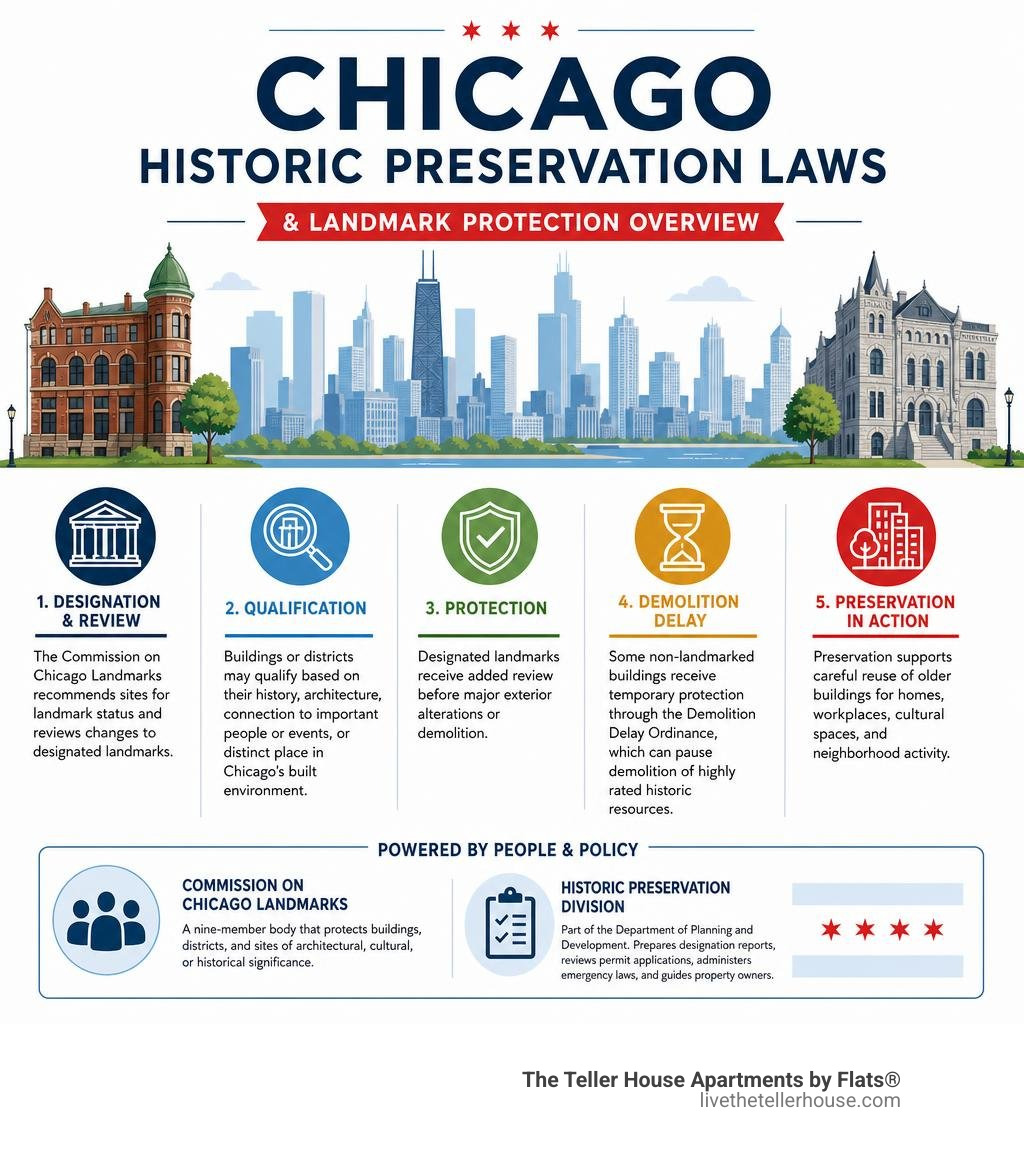
- The Commission on Chicago Landmarks recommends sites for landmark status and reviews changes to designated landmarks.
- A building or district may qualify based on its history, architecture, connection to important people or events, or distinct place in Chicago's built environment.
- Designated landmarks receive added review before major exterior alterations or demolition.
- Some non-landmarked buildings also receive temporary protection through the Demolition Delay Ordinance, which can pause demolition of highly rated historic resources.
- Preservation is not just about looking backward. It can support careful reuse of older buildings for homes, workplaces, cultural spaces, and neighborhood activity.
Chicago's history is visible in its boulevards, industrial buildings, theaters, greystones, early skyscrapers, and community landmarks. The rules behind their protection can seem complex, but they shape what remains, what changes, and how the city carries its architectural story forward.
Regulatory Framework of Chicago Historic Preservation
Understanding how local laws protect historic architecture requires exploring the primary municipal entities and legal statutes that oversee our built heritage. The regulatory backbone of chicago historic preservation centers on a structured system designed to evaluate, protect, and approve updates to historically significant structures.
At the core of this system is the Commission on Chicago Landmarks, a nine-member municipal body created to safeguard the city's architectural gems. Working alongside the Commission is the Historic Preservation Division, housed within the Department of Planning and Development. This administrative division prepares comprehensive designation reports, reviews construction permit applications, administers emergency protection laws, and assists property owners navigating preservation guidelines.
The statutory authority for all municipal preservation activity comes directly from Title 2, Chapter 120, Article XVII of the Municipal Code of Chicago, commonly referred to as the Landmarks Ordinance. Established in its modern legal form in 1968 after initially operating as an advisory board from 1957, the Landmarks Ordinance sets clear standards for designating structures and reviewing permit requests.
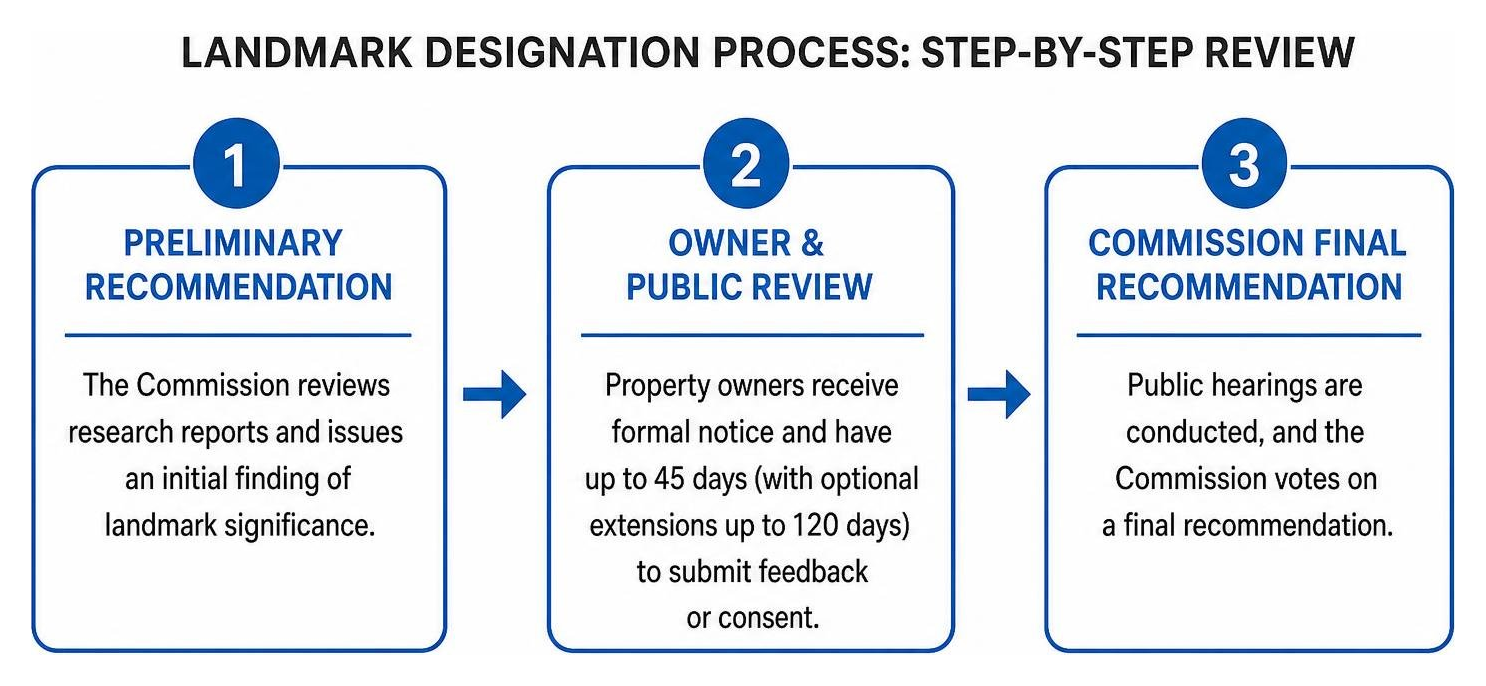
When the Commission evaluates a property and issues a preliminary recommendation for landmark designation, a defined legislative timeline begins:
- Preliminary Recommendation: The Commission reviews research reports and issues an initial finding of landmark significance.
- Owner & Public Review: Property owners receive formal notice and have up to 45 days (with optional extensions up to 120 days) to submit feedback or consent.
- Commission Final Recommendation: Public hearings are conducted, and the Commission votes on a final recommendation.
- City Council Evaluation: The recommendation is submitted to the Chicago City Council for legislative enactment.
Under the ordinance, the Chicago City Council has a 365-day statutory limit to take final legislative action. If the City Council does not act on a formal landmark recommendation within this one-year timeframe, landmark status is granted automatically under municipal law.
Criteria for Designation under Chicago Historic Preservation Rules
For a building, structure, or district to earn official status as a Chicago Landmark, it must fulfill at least two of the seven official criteria established under municipal code, while also maintaining historical integrity:
- Value as an Example of City Heritage: Demonstrates clear historical, cultural, economic, or social value to the development of Chicago or the nation.
- Location of a Significant Historic Event: Represents the site of a noteworthy historical event.
- Identification with a Significant Person: Directly associated with individuals who significantly contributed to city or national history.
- Exemplary Architecture: Represents an exceptional architectural style, structural innovation, or craftsmanship detail.
- Work of a Major Architect or Designer: Designed by an architect, engineer, or master builder recognized for high achievement.
- Distinctive Theme or Pattern: Represents a cohesive visual or functional theme in urban planning or neighborhood development.
- Unique Visual or Physical Feature: Serves as a familiar visual landmark or physical anchor for a community.
In addition to meeting these criteria, a site must retain physical integrity, meaning its original character-defining elements—such as material composition, structural form, and distinctive ornamentation—remain intact.
Properties can also achieve federal recognition through the National Historic Register, though local landmark status provides the strongest legal protection against unauthorized demolition or inappropriate structural modification.
The Landmarks Ordinance also contains specific property owner exemptions. Religious buildings actively used for religious ceremonies cannot be designated as historical landmarks without explicit written owner consent. This exemption balances municipal preservation goals with property rights for religious institutions.
Demolition Delay Ordinance and Permit Reviews
Not every historic building in Chicago holds official landmark status, yet many non-landmarked properties still benefit from statutory safeguards. The primary municipal mechanism protecting these resources is the Demolition Delay Ordinance, which works in tandem with the Chicago Historic Resources Survey (CHRS).
Conducted between 1983 and 1994, the CHRS cataloged over 17,000 properties built before 1940 to assess their historic and architectural value. The survey uses a color-coded rating system to classify properties:
- Red Rating: Properties possessing individual architectural significance that meet local landmark criteria.
- Orange Rating: Buildings possessing significant architectural or historic features that add value to their surrounding neighborhood context.
- Yellow, Green, and Blue Ratings: Properties that range from possessing minor architectural interest to those constructed after the primary survey period.
When a property owner applies for a demolition permit involving a Red or Orange-rated structure, the Demolition Delay Ordinance triggers an automatic 90-day hold on permit issuance. To learn more about this survey process and how neighborhood resources are categorized, explore the guide on Chicago Historic Resources Survey & You.
During this 90-day delay, the Historic Preservation Division, community advocacy groups, and local neighbors review the property to evaluate preservation options, explore adaptive reuse strategies, or initiate emergency landmark designation proceedings when appropriate.
For properties already designated as official Chicago Landmarks, any proposed work—from window replacements and exterior brick repointing to structural additions—must undergo direct permit review by the Historic Preservation Division to ensure modifications respect original architectural guidelines.
Financial Incentives Supporting Historic Building Restoration
Preserving vintage structures requires dedicated care and investment. To make major adaptive reuse and restoration projects feasible, the City of Chicago and Cook County provide financial incentive tools designed to encourage property rehabilitation.
The most widely used financial tool for major historic building restorations is the Class L Property Tax Incentive. Administered through Cook County in partnership with the city, Class L is specifically designed to encourage the preservation and rehabilitation of commercial, industrial, and income-producing historic structures.
To qualify for Class L tax relief, property owners must meet specific municipal guidelines:
- The building must be an officially designated Chicago Landmark or a contributing building within a landmark district.
- Owners must complete an extensive, approved rehabilitation project meeting Secretary of the Interior standards.
- The minimum investment must equal at least 50% of the building's equalized assessed value (EAV) prior to rehabilitation.
When approved, Class L reduces the property's assessment rate for 12 consecutive years--dropping the standard commercial assessment rate from 25% down to 10% for the first 10 years, 15% in year 11, and 20% in year 12 before returning to standard assessment levels.
For property owners interested in learning about local municipal applications and forms, official details are available through the Historic Preservation - City of Chicago resource portal.
Citywide Adopt-a-Landmark Fund
Another key funding mechanism supporting local architectural heritage is the Citywide Adopt-a-Landmark Fund. This municipal grant initiative allocates funding generated from downtown construction projects directly to the structural restoration of individual Chicago landmarks and district properties.
The Adopt-a-Landmark Fund operates by capturing voluntary zoning payments made by downtown real estate developers through Chicago's Neighborhood Opportunity Bonus System. In exchange for additional floor area ratio (FAR) building density downtown, developers contribute fees that are diverted into funds supporting neighborhood commercial corridors and historic restoration grants.
Grants awarded through the program focus primarily on exterior restoration work, including masonry repair, copper cornice restoration, structural foundation stabilization, and roof replacements. For instance, detailed in the update WIN: City of Chicago Awards $800,000 Adopt-A-Landmark Fund to Four Chicago Landmarks, the city granted significant restoration awards to historic structures including neighborhood event venues, stone-clad former religious centers, and commercial buildings along historic transportation corridors.
The program specifically targets non-residential landmark properties and multi-family residential structures with more than six units, ensuring public preservation funds actively enhance community spaces and architectural anchors across diverse Chicago neighborhoods.
Economic Development and Urban Housing Integration
Historic preservation serves as a dynamic engine for modern economic development and sustainable urban living. By transforming underutilized commercial towers into vibrant residential communities, adaptive reuse initiatives breathe new life into vintage districts while helping address urban housing demand.
A prime example of this strategy is the city's LaSalle Reimagined initiative, which leverages Tax Increment Financing (TIF) and preservation tax credits to convert high-rise commercial office space in the Loop into modern apartment residences. These projects breathe fresh energy into downtown streets after traditional business hours while protecting iconic early 20th-century high-rise architecture.
Those exploring modern living opportunities inside preserved historic spaces can browse our selection of Chicago Historic Building Apartments to see how vintage architectural charm seamlessly pairs with high-end modern residential amenities.
Preserving existing buildings also delivers profound climate resilience benefits. The process of rehabilitating solid historic structures avoids the carbon emissions associated with new building materials and major site demolitions. Vintage construction materials--such as old-growth timber, dense masonry, terracotta, and heavy structural steel--possess incredible longevity that outlasts modern disposable finishes.
To better understand how Chicago's preservation incentives compare, review the side-by-side comparison below:
| Feature / Criteria | Class L Property Tax Incentive | Citywide Adopt-a-Landmark Fund |
|---|---|---|
| Primary Incentive Type | 12-Year Cook County Property Tax Rate Reduction | Direct Municipal Rehabilitation Cash Grant |
| Funding Source | Cook County Tax Assessment Adjustments | Downtown Commercial Zoning Density Bonus Fees |
| Eligible Property Types | Income-Producing Commercial, Industrial, and Residential | Individual Chicago Landmarks (Excludes Single-Family Homes) |
| Minimum Rehab Investment | At least 50% of Pre-Rehab Assessment Value | Varies by Grant Application Cycle |
| Primary Work Scope Focus | Comprehensive Interior & Exterior Property Rehabilitation | Exterior Envelope, Structural & Facade Restoration |
Advocacy, Education, and Community Initiatives
While municipal codes provide the legal framework for preservation, civic engagement and community advocacy provide the heartbeat. Across Chicago, dedicated non-profit organizations, educational programs, and grassroots groups work tirelessly to champion endangered architecture.
At the forefront of civic advocacy is Preservation Chicago, a non-profit organization dedicated to protecting irreplaceable architecture, historic neighborhood fabric, and open green spaces. Each year, the organization releases its highly anticipated Chicago 7 Most Endangered list, drawing public attention to threatened buildings, historic landscapes, and vulnerable architectural styles across the city.
On a national level, organizations such as the National Trust for Historic Preservation collaborate with local advocates to provide resources, technical support, and grants to protect iconic architectural sites. Together, these organizations ensure that neighborhood history remains a priority in modern urban development plans.
Modern Trends in Chicago Historic Preservation and Advocacy
In recent years, preservation advocacy in Chicago has embraced innovative approaches to protecting historic urban corridors. Rather than viewing preservation and new development as opposing forces, modern preservation trends focus on blending historical honor with functional economic revitalization.
A significant example of this modern approach occurred at 30 N. LaSalle Street in the Financial District. When plans emerged to transform the 1970s commercial tower into residential housing, preservation advocates rallied for landmark status while preserving the memory of the site's predecessor—Louis Sullivan's celebrated 1894 Chicago Stock Exchange Building, which was tragically demolished in 1972. Granting preliminary landmark status to 30 N. LaSalle unlocked essential Class L tax support for housing creation while officially incorporating the salvaged Stock Exchange Trading Room and Entry Arch (now preserved at the Art Institute of Chicago) into the site's recognized historical heritage.
Simultaneously, the landmarking of the Rector Building at 79 W. Monroe Street highlights the power of adaptive reuse. For full context on this landmark victory, read WIN: Final Landmark Recommendation Approved for Rector Building / Bell Federal at 79 W. Monroe Street. Designed by Jarvis Hunt in 1905 with later additions by Holabird & Roche, this 14-story classical high-rise is being repurposed into 117 modern residential apartments while retaining iconic exterior elements like its historic 1950s "Weather Bell" clock.
Grassroots advocacy campaigns also extend into neighborhood parish structures. For example, community members launched a rapid-response campaign to protect St. Mary of the Assumption on the Far South Side, highlighting its historical connections and architectural value to save the mid-century parish campus from demolition. For further details on this campaign, view THREATENED: Rapid Response Advocacy Campaign to Landmark Pope Leo’s Childhood Church Gains Traction.
Academic Programs and Local Heritage Initiatives
Advancing preservation practice requires specialized education and community-driven historical documentation. Chicago benefits from world-class academic leadership and grassroots programs that train future conservation leaders.
The School of the Art Institute of Chicago (SAIC) offers a renowned Master of Science in Historic Preservation. This rigorous two-year, 60-credit graduate program trains students in restoration design, materials science, preservation planning, and architectural history. SAIC faculty and students regularly contribute to real-world local initiatives, such as documenting Chicago's historic bascule bridges, surveying mid-century suburban architecture, and maintaining digital archives like the Building Technology Heritage Library.
On the community level, local heritage preservation initiatives work alongside the Department of Planning and Development to identify, document, and preserve sites central to neighborhood social history. By focusing on grassroots oral histories and cultural anchors, these initiatives expand preservation beyond purely aesthetic architectural styles to celebrate diverse community narratives.
In addition, historic neighborhood districts—such as the Logan Square Boulevards District, which protects stately greystones along wide, leafy boulevards—showcase how neighborhood-level designation protects historic streetscapes from out-of-scale redevelopment. Those looking to explore distinct architectural styles across the city can consult our comprehensive guide on Chicago Heritage.
Landmark Sites Open to the Public Across Chicago

One of the greatest joys of living in or visiting Chicago is experiencing its historical architecture firsthand. Many of the city's most celebrated landmarks welcome the public for tours, cultural programming, and overnight stays.
To plan your architectural exploration around the city, consult the curated travel recommendations in 8 Historic Sites to Explore in Chicago. Key public landmarks across the metropolitan area include:
- Unity Temple: Designed by Frank Lloyd Wright in 1908 and located in nearby Oak Park, this concrete masterpiece is Wright's last surviving public building from his Prairie period and was named a UNESCO World Heritage Site in 2019.
- Old Cook County Hospital: Built in 1914, this magnificent 550-foot-long Beaux-Arts landmark in the Illinois Medical District underwent a monumental adaptive reuse transformation, reopening in 2021 as a mixed-use hotel, office, and museum space.
- Glessner House: Completed in 1887 by architect Henry Hobson Richardson, this Prairie Avenue masterpiece redefined American domestic architecture with its Richardsonian Romanesque design and courtyard-facing floor plan.
- Pullman National Historical Park: Located on the Far South Side, this 300-acre industrial site established in 1880 features factory buildings, worker housing, and historic administrative centers that hosted key moments in American labor history.
Exploring these public landmarks provides a masterclass in architectural engineering and cultural history. For those seeking to live inside historically significant properties, learn more about residential options through our comprehensive guide to Leasing Historic Properties in Chicago.
If you are researching vintage rental homes and apartments across the city, explore our additional guides on finding Historic Apartments in Chicago, browsing Historic Apartments Chicago, selecting Chicago Historic Apartments for Rent, navigating the Vintage Apartments Chicago Guide 2026, reading the Vintage Chicago Apartments Guide 2026, or consulting our complete Chicago Historic Homes Guide.
Frequently Asked Questions About Local Landmark Policies
How does a building become an official Chicago Landmark?
A building becomes an official Chicago Landmark through a multi-step municipal process governed by the Landmarks Ordinance. First, the Historic Preservation Division conducts archival research and presents a preliminary report to the Commission on Chicago Landmarks. If the Commission grants preliminary approval, the property owner is formally notified and given time to consent or provide feedback.
Following public hearings, the Commission votes on a final landmark recommendation. The recommendation is then submitted to the Chicago City Council for review. Once approved by the City Council—or automatically after 365 days if no legislative action is taken—the property receives official landmark status.
What triggers the 90-day Demolition Delay Ordinance in Chicago?
The 90-day Demolition Delay Ordinance is triggered whenever a demolition permit application is submitted for a property rated "Orange" or "Red" in the Chicago Historic Resources Survey (CHRS).
Once triggered, the Department of Buildings places an automatic 90-day hold on the permit. During this period, city officials, preservation specialists, and community groups review the structure's architectural integrity, explore adaptive reuse alternatives with the property owner, or consider nominating the building for official Chicago Landmark designation.
Are religious structures exempt from landmark designation?
Under Chapter 2-120-610 of the Municipal Code of Chicago, religious structures actively used primarily for religious worship or ceremonies cannot be designated as Chicago Landmarks without the explicit written consent of the property owner.
This exemption protects the constitutional religious freedom of faith organizations. However, if a religious institution consents to designation, or if a historic former religious building is sold to a non-religious entity for adaptive reuse, standard landmark nomination procedures apply.
Conclusion
Chicago's historic preservation laws do far more than shield old buildings from demolition—they provide a practical roadmap for sustainable urban growth, creative neighborhood investment, and community storytelling. By combining robust statutory protections like the Landmarks Ordinance with strong tax incentives like the Class L program, Chicago proves that architectural heritage and modern urban living thrive hand in hand.
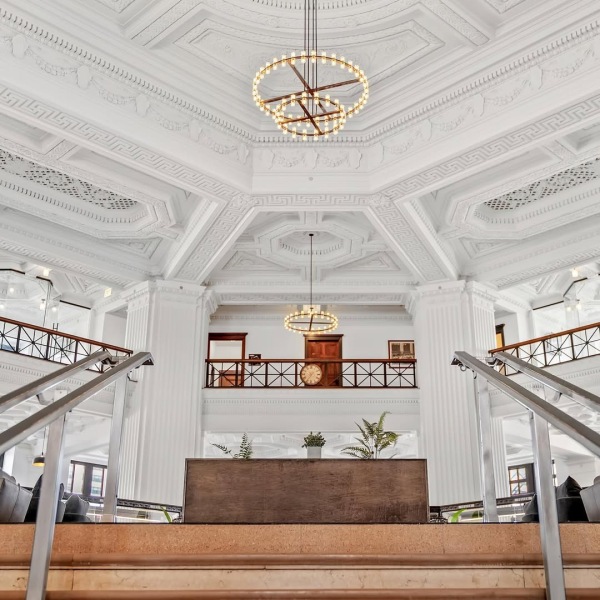
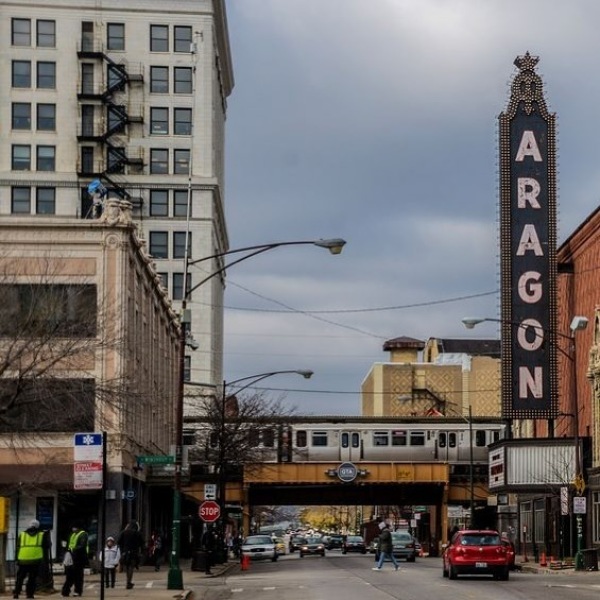
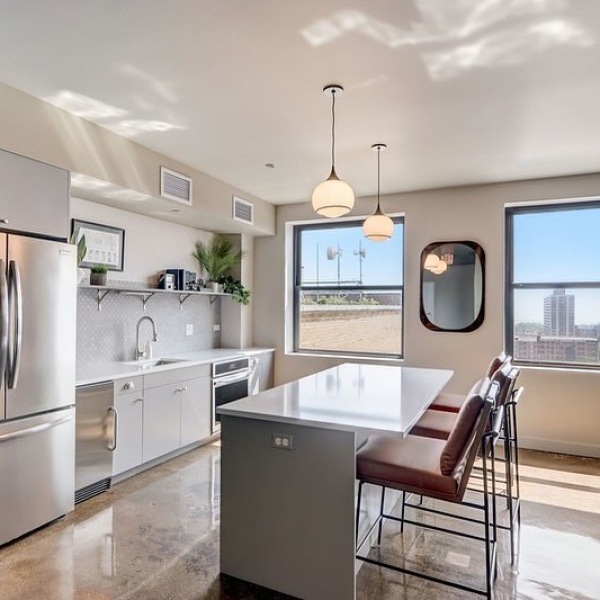
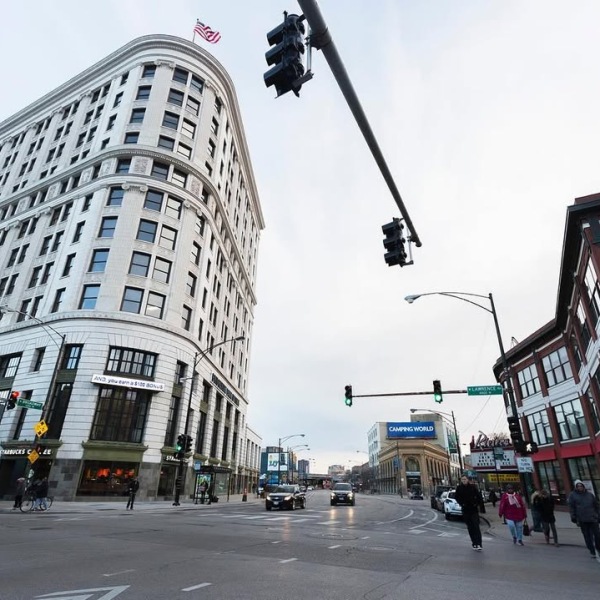
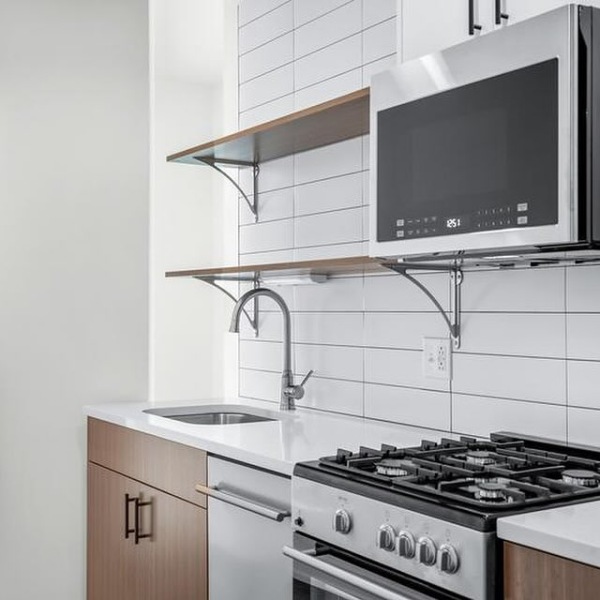
At The Teller House Apartments by Flats®, we take immense pride in being part of this living architectural tradition. Located in vibrant Uptown Chicago near iconic historic theaters and cultural venues, our community transforms a grand historic bank building into sophisticated modern apartment residences. By preserving stunning vintage architectural detailing while integrating upscale contemporary finishes, we offer residents an exceptional living experience grounded in Chicago's rich heritage.
If you are ready to experience the perfect blend of historic elegance and modern luxury, explore our available residences today by visiting Explore Historic Apartments for Rent.