

What Is Cook Housing and How Do You Find It?
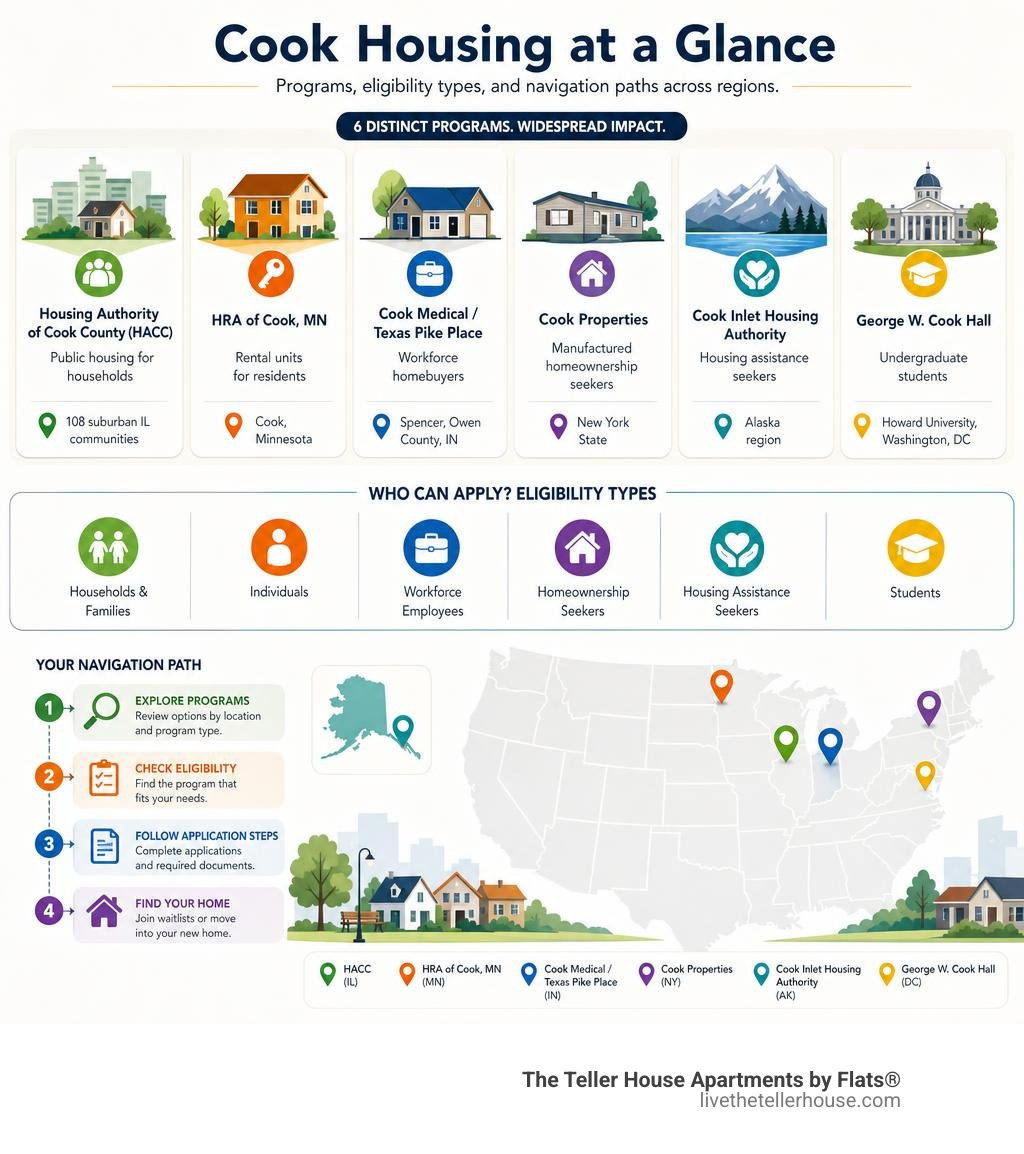
Cook housing covers a wide range of administrative programs, local authorities, and specialized residential developments — and knowing where to start makes all the difference. Here's a quick snapshot of the main options available across different regions:
| Cook Housing Type | Who It Serves | Where |
|---|---|---|
| Housing Authority of Cook County (HACC) | Households seeking public housing options | 108 suburban IL communities |
| HRA of Cook, MN | Residents needing rental housing units | Cook, Minnesota |
| Cook Medical / Texas Pike Place | Workforce homebuyers | Spencer, Owen County, IN |
| Cook Properties | Manufactured homeownership seekers | New York State |
| Cook Inlet Housing Authority | Housing assistance seekers | Alaska region |
| George W. Cook Hall | Undergraduate university students | Howard University, DC |
Finding the right housing resource can feel overwhelming when first starting your search. "Cook housing" isn't one single uniform program — it represents a broad collection of distinct residential initiatives spread across multiple states, each featuring its own eligibility guidelines, waitlist procedures, and application steps.
Some initiatives are operated directly by municipal housing authorities. Others are driven by corporate employers or private residential site operators. A few hold historical significance or serve university campus populations.
The Housing Authority of Cook County alone supports more than 15,000 households across 108 distinct communities in suburban Illinois. Meanwhile, Cook Medical has committed to building 300 homes across south-central Indiana to address local inventory shortages for workforce participants. In New York State, private operators manage more than 7,000 home sites across 100+ manufactured home communities.
Each path requires different application steps — and this comprehensive guide walks you through every major option to help you navigate your options effectively.
Overview of Regional Cook Housing Programs
When examining the broader landscape of regional cook housing initiatives, you will find a distinct mix of municipal developments, employer-led projects, and community housing options. These programs are structured to help local residents secure dependable living arrangements. From workforce residential developments to county housing operations, learning how these frameworks function enables applicants to select the ideal living setup for their personal scenario.
One notable initiative in workforce housing is spearheaded by Cook Medical in Owen County, Indiana. Through employer reinvestment, capital generated from commercial sales has been directed into constructing single-family subdivisions such as Texas Pike Place. By establishing designated residential lots in proximity to major employment hubs, this model creates straightforward pathways for area employees to transition into homeownership. To explore this regional initiative in detail, visit Cook Housing Initiatives.
Qualifying for Employee Cook Housing Developments
Corporate-sponsored residential subdivisions follow clear, sequential steps for prospective homebuyers. For developments like Texas Pike Place in Spencer, Indiana, interested participants submit standard preapproval documentation through designated lending institutions prior to executing formal purchase agreements.

The selection framework prioritizes active workforce members at participating employers before expanding enrollment opportunities to the broader community. These single-family properties showcase varied lot layouts—often measuring around 100 feet by 150 feet—with floor plans spanning 1,100 to 1,800 square feet featuring 3 to 4 bedrooms and 2 bathrooms.
Community Impact of Workforce Residential Projects
Employer-backed residential development plays an essential role in mitigating housing supply shortages across regional employment corridors. When growing businesses invest directly in local residential infrastructure, they offer regional workers manageable commute times and lasting community connections.
- Direct proximity to main employment centers, minimizing daily travel requirements.
- Long-term community growth, encouraging continued municipal investment and local services.
- Expanded homeownership opportunities that maintain healthy residential balance across growing towns.
Public Housing Authorities and Municipal Operations
Local housing authorities form the core foundation of civic residential support. Across Illinois, the Housing Authority of Cook County (HACC) administers public housing options, voucher programs, and property management services for over 15,000 households across 108 suburban municipalities. Meanwhile, municipal authorities such as the Housing and Redevelopment Authority (HRA) of Cook, Minnesota, manage local multi-family rental buildings in smaller geographic regions. Prospective residents searching for opportunities in Illinois can review Cook County Apartments for localized housing details.
Navigating Waitlists and Application Procedures
Securing a multi-family rental unit through public housing authorities requires an understanding of program availability cycles and waitlist announcements. Because occupancy rates stay high across suburban jurisdictions, housing agencies manage participant intake through scheduled application windows.
To participate in HACC programs, applicants can register on the Housing Authority of Cook County Portal. When waitlists open for individual multi-family properties or Project-Based Vouchers, registered account holders receive direct email notifications to submit updated contact details, household size documentation, and standard verification records.
Minnesota Rental Developments and Cook Housing Resources
In northern regions, municipal agencies operate specialized residential properties tailored to local community needs. The HRA of Cook, Minnesota, manages localized apartment complexes and duplex units, including properties participating in federal frameworks like the Rental Assistance Demonstration (RAD).
Residents seeking regional housing details can consult City of Cook MN Housing Services or review detailed housing profiles through Public Housing Resources Information. Program guidelines establish general eligibility standards according to household composition:
- Individual occupant households: Standard household evaluation baseline
- Two-member households: Adjusted eligibility parameter limit
- Three-member households: Mid-size household standard threshold
- Four-member households: Larger household standard qualification threshold
Urban Housing Communities and Urban Redevelopment
In major metropolitan centers like Chicago and surrounding Cook County communities, residential initiatives focus on transforming older housing structures into modern mixed-income developments. The Chicago Housing Authority (CHA) has directed significant community revitalization efforts in historic neighborhoods such as Bronzeville, converting former residential structures into vibrant developments that integrate standard residential units alongside public housing options.
To gain insights into regional housing trends, readers can consult our comprehensive Apartments for Rent Cook County Guide 2026 as well as dedicated neighborhood resource pages for Apartments for Rent in South Suburban Cook County.
| Community Type | Primary Focus | Key Features | Governance / Structure |
|---|---|---|---|
| Suburban Public Housing | Multi-family housing across 108 communities | Project-based vouchers & periodic waitlists | Housing Authority of Cook County (HACC) |
| Mixed-Income Redevelopments | Urban revitalization (e.g., Bronzeville) | Integrated community housing and tenant selection plans | Chicago Housing Authority (CHA) & Private Partners |
| Corporate Workforce Housing | Regional employee residential plots | Single-family homes near employment hubs | Employer-backed development corporations |
| Manufactured Home Communities | Land-lease residential sites | Single-family manufactured home plots | Private operational groups (e.g., Cook Properties) |
Urban mixed-income redevelopments utilize structured resident selection guidelines to maintain community standards. Returning residents frequently complete employment or vocational training activities—typically around 30 hours per week—and complete background screening to support positive community integration and lasting neighborhood vitality.
Historic and Academic Cook Housing Sites
Beyond modern rental communities and workforce subdivisions, several notable properties sharing the Cook name possess rich historical or academic significance:
- The Historic Cook House (Parkersburg, WV): Constructed in 1825 by Tillinghast A. Cook, this historic brick residence remained in the stewardship of a single family for 185 years until 2010. As one of the oldest surviving structures in Wood County, it now serves as an educational museum highlighting regional history and architectural heritage. Learn more by visiting The Historic Cook House.
- George W. Cook Hall (Howard University, Washington, D.C.): Named in honor of the esteemed educator, this university residence hall traditionally accommodates approximately 200 undergraduate students. The facility undergoes regular maintenance and structural updates to maintain contemporary living spaces and student amenities. Details are available at George W. Cook Hall Overview.
Frequently Asked Questions About Cook Housing
How do housing authority waitlists work in Cook County?
Housing authority waitlists open periodically based on overall property occupancy levels and turnover rates. Applicants create accounts through official online portals to receive direct notifications when application periods open, at which point they submit updated household information and verification records.
What are the main requirements for workforce residential developments?
Workforce housing developments typically require prospective buyers to complete preapproval steps with participating mortgage lenders, fulfill employment priority criteria with participating regional businesses, and adhere to community residential covenants.
Where can prospective residents access municipal real estate databases?
Prospective residents, home buyers, and real estate researchers can access official public records through the Cook County Assessor's website to look up 14-digit Property Identification Numbers (PINs), evaluate property records, or confirm property deeds through official county recording offices.
Conclusion
Navigating the various facets of cook housing requires an understanding of different regional programs, public housing authority procedures, and employer-backed developments. Whether you are tracking public housing waitlists in Cook County, exploring workforce housing opportunities in growing communities, or seeking premium urban rental homes, staying informed empowers you to choose the best option for your lifestyle.
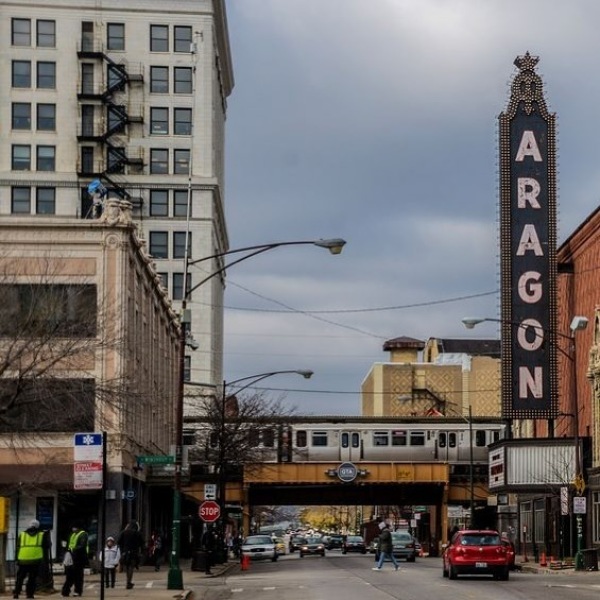
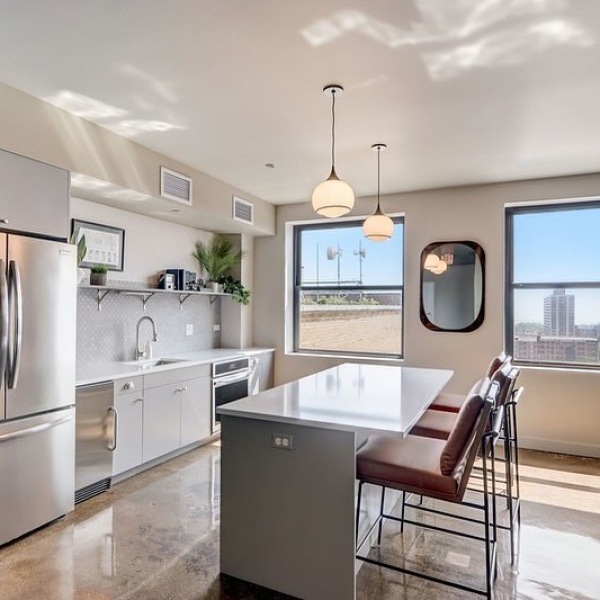
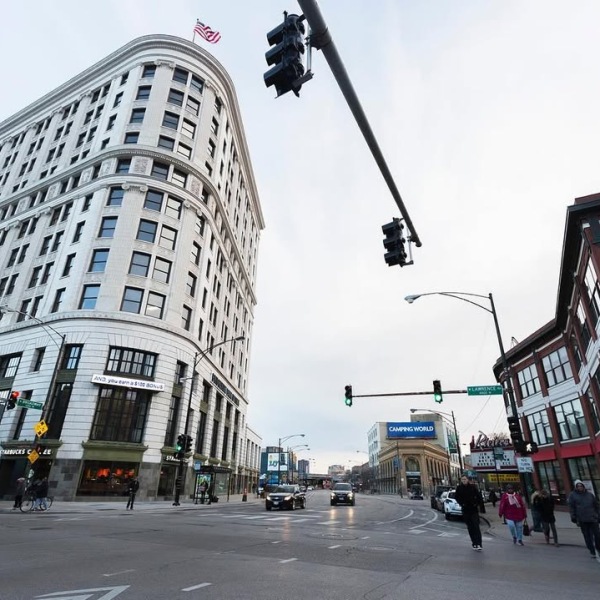
At The Teller House Apartments by Flats®, we offer exceptional apartment living in historic Uptown Chicago. By harmonizing historic architectural details with modern living spaces, we provide beautiful residences steps away from celebrated cultural venues and entertainment hubs. Discover your next home by reviewing our complete guide to Apartments for Rent in Chicago and connect with our team today.